The Iola-Scandinavia School District’s latest academic report cards show that all district schools officially exceed state expectations, driven by student growth metrics that rank among the highest in Wisconsin.
According to recent data from the Wisconsin Department of Public Instruction, both Iola-Scandinavia Elementary School and Iola-Scandinavia Middle/High School earned four-star ratings under the state’s accountability system. The designation highlights how strong academic progression can offset lower raw proficiency benchmarks.
Statewide results show that 48.4% of students in grades 3 through 11 scored proficient or above in English language arts. In comparison, public school students alone averaged 49.7%. In mathematics, 48.7% of students statewide reached proficiency, with public school students at 50.2%.
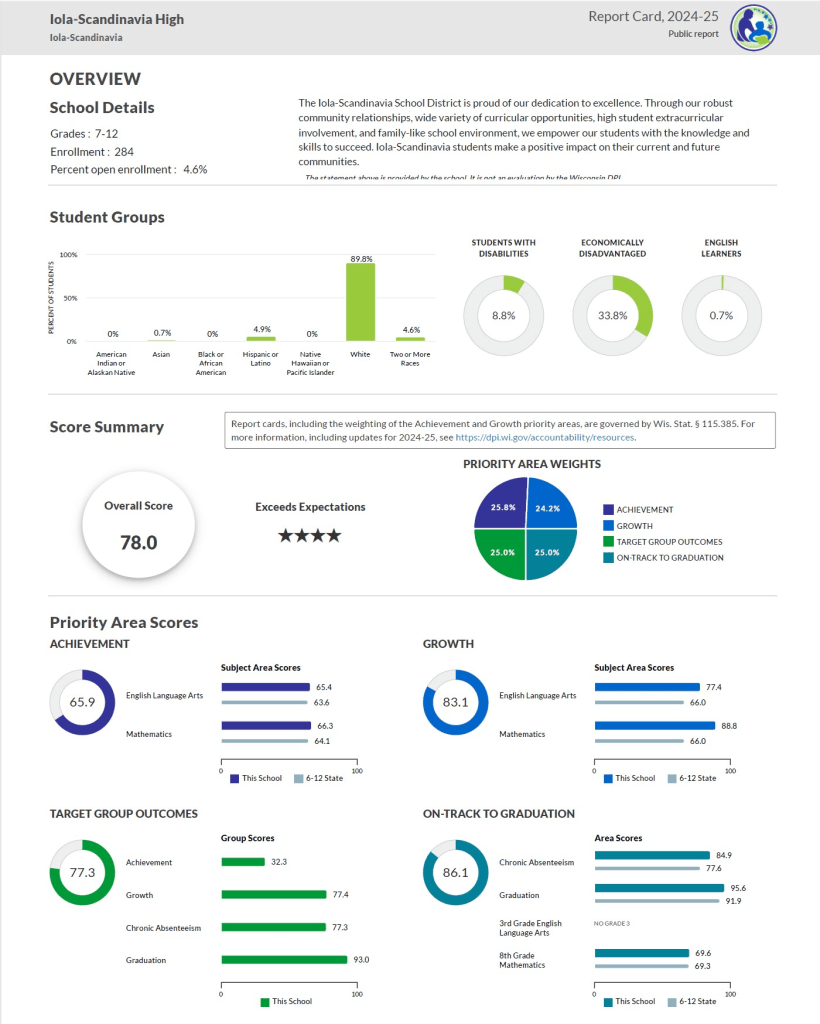
While older, third-party snapshots captured lower static proficiency rates for the district, updated DPI data and standard-setting adjustments reflect a much stronger performance. Iola-Scandinavia Elementary School registered a 63% proficiency rate in English language arts and 56% in mathematics, contributing to a 9.6-point surge in its overall composite score.
The district’s most notable achievement came from Iola-Scandinavia Middle/High School, which ranked at the top of the state for academic student growth.
The DPI uses a value-added growth model to measure how quickly students progress from year to year. School officials noted that this high-growth trajectory shows local students are accelerating their learning pace faster than peers in most Wisconsin public schools, placing the district at the top of Waupaca County.
The Wisconsin Forward Exam is administered in English language arts and mathematics in grades 3 through 8, in science in grades 4 and 8, and in social studies in grades 4, 8, and 10. It is designed to evaluate how well students are mastering the Wisconsin Academic Standards.
While statewide data shows fewer than half of tested students reached overall proficiency in either core subject, value-added metrics ensure districts like Iola-Scandinavia are recognized for substantial year-over-year student improvement.
How the DPI system works
Wisconsin’s school accountability system prioritizes student learning velocity over static test performance, allowing districts to earn high state marks even when fewer than half of their students meet absolute proficiency benchmarks.
The mathematical gap between low test scores and high state ratings stems from the state Department of Public Instruction’s complex grading formula. The system intentionally separates a student’s academic standing from how quickly a school helps them improve.
State education officials say the report cards are designed to measure a school’s instructional impact rather than a student’s fixed testing snapshot.
According to DPI guidelines, the growth metric measures how much progress a student makes compared to academic peers statewide who started the school year at the exact same achievement level. This means a student who enters a grade reading two years behind but finishes the year only one year behind is credited with significant academic growth, even though they remain classified as below proficient.
The state’s formula dynamically adjusts based on a district’s demographics. For schools with higher percentages of economically disadvantaged students, the state weights year-over-year growth metrics more heavily than raw achievement scores.
Accountability scores also track target-group outcomes, a metric that isolates the progress of the lowest-performing 25% of students. Schools that successfully close these internal achievement gaps earn additional points that lift their overall rating.
Beyond standardized testing, non-test indicators like chronic absenteeism reduction, graduation rates, and daily attendance comprise up to a quarter of a school’s overall score. Strong performance in these foundational areas can cushion the impact of lower math and reading marks, helping local districts secure “exceeding expectations” designations.
How it applies to Iola-Scandinavia
High rates of academic growth have propelled schools in the Iola-Scandinavia School District to high state marks, showing how rapid student learning can offset lower raw test-day scores.
According to recent accountability data from the Wisconsin Department of Public Instruction, both campuses in the district officially earned “exceeds expectations” designations, equivalent to four-star ratings out of five. The performance lands the district among the top-tier school systems in Waupaca County and Cooperative Educational Service Agency 5.
The district’s ratings highlight how the state’s grading system functions. Under Wisconsin rules, a school can achieve top accountability rankings even if fewer than half of its students meet absolute proficiency benchmarks. The state formula deliberately separates static achievement snapshots from annual growth metrics.
At Iola-Scandinavia Middle/High School, strong year-over-year progress put the school at the top of the state for academic student growth. Officials note that roughly 33.8% of the school’s student body is classified as economically disadvantaged, which triggers a heavier formulaic emphasis on growth rather than raw test scores.
By prioritizing student progress over academic peers statewide who started at the same testing level, the state’s value-added growth model credited the middle and high school campus with accelerating learning faster than nearly any other public school in Wisconsin.
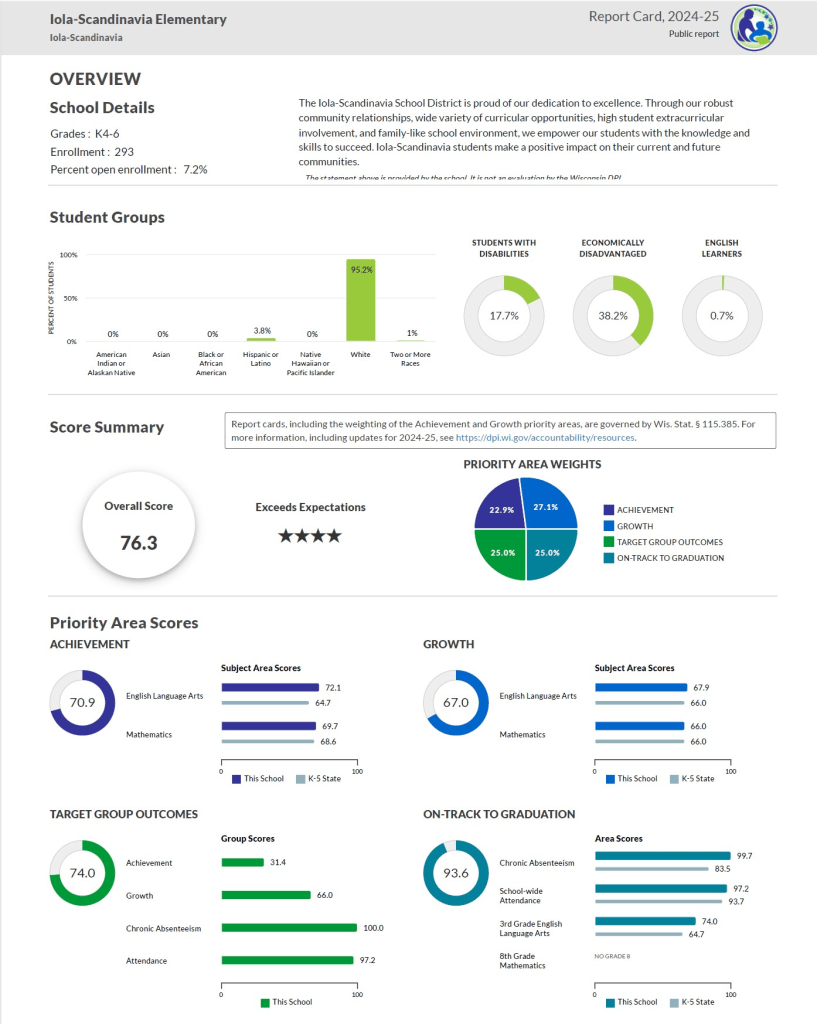
Meanwhile, Iola-Scandinavia Elementary School recorded a 9.6-point surge in its overall composite score. State adjustments to standard-setting baselines recorded a 63% proficiency rate in English language arts and a 56% proficiency rate in mathematics for the elementary school.
The elementary campus also had an anchor metric in the non-test category, with a 94.98% student attendance rate. Daily attendance figures carry strong mathematical weight in the state formula to evaluate how well schools keep students on track toward graduation.
Statewide data indicates that fewer than half of all tested students reached overall proficiency in core subjects. However, state education leaders say value-added models prevent districts from being penalized for initial demographic baselines if their educators successfully compress learning gaps.
Other districts comparison
Both the Tomorrow River School District and the Waupaca School District earned “exceeds expectations” designations under the state’s accountability framework, achieving matching four-star classifications despite differences in raw test scores.
The Wisconsin Department of Public Instruction’s findings mirror regional education patterns, where high rates of year-over-year student learning growth often offset static, test-day snapshots.
In a direct comparison of static test proficiency, the Waupaca School District holds a slight advantage over Tomorrow River in raw subject marks. State tracking data show Waupaca students achieved average math proficiency of 48% and reading proficiency of 44%. Both figures exceed historical public school state averages of 40% in math and 39% in reading.
By contrast, the Tomorrow River School District, based in Amherst, recorded a 34% proficiency rate in mathematics and a 41% proficiency rate in reading during corresponding baseline periods.
However, state education leaders emphasize that fixed achievement scores do not tell the whole story. Wisconsin’s value-added growth formula measures student progress relative to academic peers statewide who started the year at the same testing level. Driven by this growth velocity, Waupaca previously saw a major surge in its accountability index to an overall score of 80, positioning it as a top performer within Cooperative Educational Service Agency 5.
Tomorrow River’s balanced score is anchored by standout structural successes within its individual campus pipelines. For instance, Tomorrow River Community Charter School registered a school-level metric of 59% proficiency in English language arts.
Both school systems also earned significant credit in non-test categories like attendance, which carry heavy mathematical weight under the state’s grading formula to evaluate long-term graduation readiness. The Waupaca Learning Center Elementary School recorded a 94.71% daily student attendance rate. In comparison, Tomorrow River Community Charter reported a close 93.53% rate.
DPI officials noted that these strong attendance baselines keep students on track to graduate, buffer the impact of raw testing deficits, and show that both rural districts successfully maximize student engagement.
Why the referendum matters
Voters in the Iola-Scandinavia School District have a critical opportunity to protect a top-tier educational system by supporting the upcoming operational referendum. Recent data from the Wisconsin Department of Public Instruction (DPI) confirms that every school in the district officially “exceeds state expectations,” earning a prestigious four-star rating and placing the district at the top of Waupaca County.
The state’s accountability system prioritizes student learning velocity over static, single-day test scores. Under this model, Iola-Scandinavia Middle/High School ranked at the absolute top of the state for academic student growth.

Local educators are accelerating student learning faster than nearly any other public school in Wisconsin, closing achievement gaps for all students, including the 35.9% classified as economically disadvantaged at the district level, 38.2% at the elementary school, and 33.8% at the middle/high school.
Meanwhile, Iola-Scandinavia Elementary School achieved a 9.6-point surge in its overall composite score. The elementary school achieved a 63% proficiency rate in English language arts, a 56% proficiency rate in mathematics, and a stellar 94.98% daily student attendance rate.
Passing the referendum is vital to maintaining this state-leading academic momentum. Referendum funding directly sustains the instructional staffing, specialized programs, and daily operations that drive these exceptional growth metrics. Without this local support, the district risks cuts that could compromise the framework that keeps local students outperforming their statewide peers. High-performing schools protect property values and keep the community thriving.
The district needs to stop personnel bleeding if voters want to drive high student growth, especially in middle school grades, to offset the typical “slump.” Administrators must also replicate neighboring districts’ structural success by identifying students who slip behind during the transitional 6th-to-8th grade window and scheduling blocks of intensive, targeted math and reading support.
Additionally, the district should maintain fidelity to Wisconsin’s Act 20 “Science of Reading” mandates by prioritizing professional development dollars to retrain K-3 teachers in phonics-based instruction. High raw proficiency can mask underlying structural gaps; equipping every elementary educator with diagnostic screening tools will catch struggling readers early, boosting the district’s foundational Growth indices.
Achieving excellence requires money, and today, with inflation and added costs for staff, materials, and building and property maintenance, it costs a significant amount. Voters deserve to know the return on their investment in statewide test scores, graduation rates, and post-secondary placement so each student can be a productive citizen in our society. A yes or no on the school district referendum signals whether you accept or reject the school district’s success in that mission.